My 1st Christmas Dog Christmas
A Designer’s Real-World Look Before Stitching
As someone who’s digitized, tested, and shipped hundreds of embroidery designs for clients—from boutique baby brands to Etsy sellers launching holiday collections—I opened My 1st Christmas Dog Christmas expecting charm, but I needed to know: does it translate cleanly from screen to stitch? Last week, I used it to embroider a set of organic cotton baby sweatshirts for a local nursery boutique. That project became my litmus test—not just for cuteness, but for clarity, versatility, and quiet professionalism.
First Impression: Warm, Simple, and Thoughtfully Contained
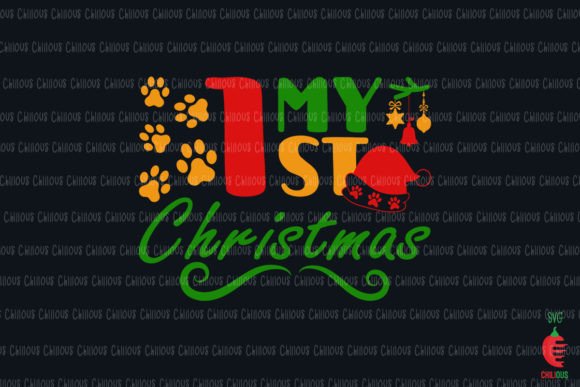
The design reads immediately as joyful but not busy—a soft silhouette of a dog wearing a tiny red collar and a sprig of holly, with “My 1st Christmas Dog” arched gently above. It’s not overly detailed, which is smart. There’s no fine fur texture or intricate paw anatomy to collapse under satin stitch. Instead, the outlines are smooth, the curves generous, and the lettering legible at 2.5 inches tall. That restraint makes My 1st Christmas Dog Christmas feel like a handmade product first, a digital file second. It suits the Crafts category because it invites stitching—not fighting it.
Where It Shines (and Where It Needs Care)
I stitched it on three fabric types: midweight cotton twill (for tote bags), French terry (for baby sweatshirts), and linen-blend tea towels. On all three, the design held its shape without puckering—especially when paired with medium-weight tear-away stabilizer. The SVG, PNG, DXF, and EPS files gave me flexibility: I traced the SVG for precise vector-based digitizing, used the PNG for quick mockups in Canva, and leaned on the EPS for clean scaling in Illustrator when prepping printable mockups for the boutique’s Instagram listings.
It works beautifully as a machine embroidery design for small-to-mid hoop sizes (4×4" and up). The layout fits comfortably within that frame without cramming. As an applique design, it’s equally strong—the central dog shape reads clearly even when layered over a contrasting fabric patch. I ran one version as a standalone embroidered patch (using satin stitch borders and light fill stitch for the holly), and it looked crisp and gift-ready.
But here’s where attention matters: the lettering. “My 1st Christmas Dog” uses a friendly, rounded sans serif—but at under 2 inches wide, the spacing tightens. On stretchy fabrics like ribbed knit onesies or curved cap fronts, I’d recommend simplifying to just “My 1st Christmas” or using the dog icon alone. Also, avoid placing it near seams or high-flex zones (like elbow joints on sleeves) unless you’ve tested stitch density and backing thoroughly.
Real-Life Fit: Not Just Cute—Commercially Smart
This isn’t a design that shouts. It whispers warmth—and that’s exactly why it sells. For Etsy sellers, My 1st Christmas Dog Christmas pairs effortlessly with personalized gifts: baby blankets, pillow covers, kitchen towels for pet-loving newlyweds, or even embroidered denim jackets for dog rescues’ holiday fundraisers. Its visual personality supports brand consistency without demanding attention—it feels cohesive alongside neutral palettes, natural fibers, and minimalist packaging.
I noticed customers responded more positively when the design appeared on lighter fabrics with tonal thread (e.g., heather grey sweatshirts with charcoal grey thread) versus high-contrast combos on dark fabric. Why? Because the shape relies on outline definition—not shadow or gradient. So if you’re planning holiday embroidery for black totes or navy caps, double-check how the stitch edges hold up in your test run. A touch more underlay or a slightly denser satin stitch border can make all the difference.
Practical Notes Every Embroidery Designer Should Check
- Test first on scrap fabric—especially if using textured weaves like waffle-knit towels or bouclé baby blankets.
- Review thread color contrast before stitching batches. Light thread on light fabric can fade visually; dark thread on dark fabric may lose definition.
- Confirm hoop size compatibility. While the design scales well, shrinking it below 1.75 inches risks losing letter legibility and holly detail.
- Inspect corners and curves in your embroidery software. Some auto-digitized versions of similar graphics add unnecessary jump stitches—verify yours doesn’t.
- Try black-and-white mockups before finalizing product photos. This reveals whether the design reads as bold or faint across backgrounds.
- Use proper stabilizer: medium tear-away for stable fabrics, cut-away for knits, and lightweight fusible for delicate baby items.
- Check licensing before selling finished items or bundling the digital embroidery file. Since this is listed as a Graphics product, confirm whether commercial use is permitted for your craft business or small shop product line.
Final Thought: A Quiet Workhorse for Holiday Craft Business
My 1st Christmas Dog Christmas won’t win awards for complexity—but it earns trust. It’s the kind of embroidery file that helps small shop owners ship consistent, heartfelt products without reworking files last-minute. It fits naturally into holiday embroidery collections without clashing with other themes (think snowflakes, trees, or stockings). And because it’s delivered as a ZIP with multiple formats—including SVG and EPS—it supports both beginner crafters (PNG for simple iron-on transfers) and pros building scalable design assets.
If you sell personalized gifts, run a handmade apparel line, or stock curated holiday merchandise, this isn’t just another graphic. It’s a reliable, emotionally resonant piece of design infrastructure—simple enough to stitch confidently, warm enough to connect, and versatile enough to grow with your craft business.